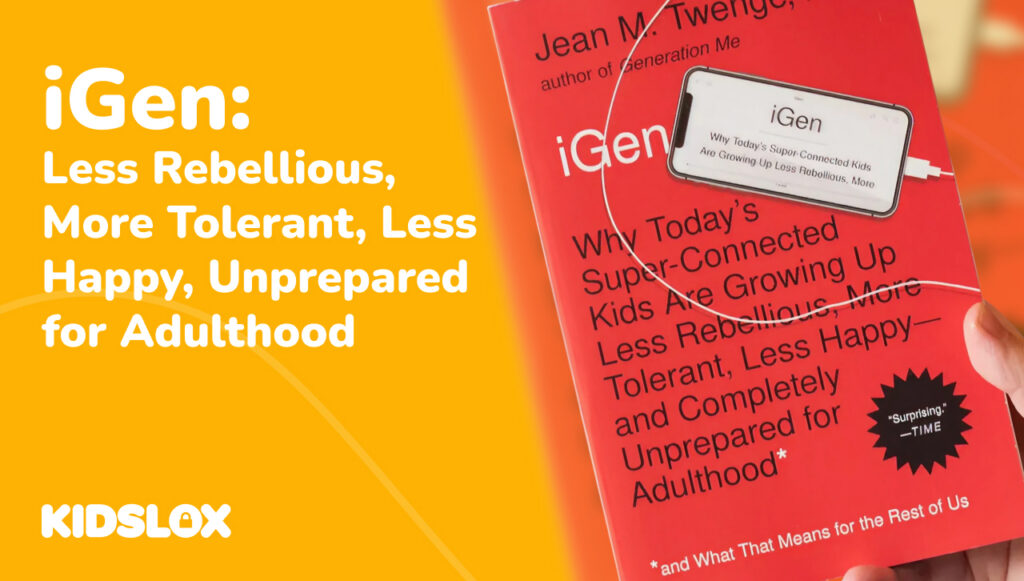
Reviewing Why Today’s Super-Connected Kids are Growing Up Less Rebellious, More Tolerant, Less Happy – and Completely Unprepared for Adulthood – and What That Means for the Rest of Us
Key Takeaways: iGen by Jean Twenge
- iGen argues that smartphones have fundamentally changed childhood, linking increased screen time to rising anxiety, loneliness, and delayed independence in teens.
- Jean Twenge suggests today’s teenagers are less rebellious but also less prepared for adulthood than previous generations.
- The book draws on large datasets and eye-catching graphs, but often relies on surface-level analysis rather than deep explanation.
- Parents can take value from the call to protect sleep, real-world friendships, and offline time,without buying into generational panic.
Once you’ve got your head around the tongue twister of a title, ‘iGen’, seeks to spell out how smartphones have shaped an entire generation of children, and why that matters now – and into the future.
If you are a parent of a teenager, or even a pre-teen, chances are you’ve had moments of real unease about technology. You might worry that your child spends too much time on their phone, struggles to switch off at night, or seems more comfortable texting than talking. You may have wondered whether social media is making them anxious, lonely, or less resilient. Jean Twenge’s iGen speaks directly to those fears.
Twenge, a psychologist, argues that children born from around 1995 onwards: what she calls “iGen” are the first generation to grow up fully shaped by smartphones. Unlike previous generations, they don’t remember a world without the internet. They’ve grown up with Instagram before high school, instant access to friends, and constant digital entertainment. According to Twenge, this has changed not just how young people behave, but who they are.
The book makes a bold claim: smartphones and screens are not just influencing childhood, they are redefining it. For parents looking for explanations, this can feel both clarifying and alarming. But while iGen raises important points, it also simplifies a complicated reality in ways that parents should approach with caution.
The Case Against the Smartphone
Twenge’s central argument is that the rise of smartphones has coincided with a decline in teenage wellbeing. She points to large-scale survey data showing increases in anxiety, depression, loneliness, and self-harm beginning in the early 2010s. This timing, she argues, lines up almost perfectly with the moment smartphones became widespread.
Her explanation is straightforward. Screens take time away from things children need: sleep, face-to-face friendships, outdoor play, and boredom. Late-night scrolling disrupts sleep, online comparison fuels insecurity, and digital communication replaces the emotional depth of in-person connection. Even when kids are “with” their friends, they may be mentally elsewhere, checking messages or social feeds.
For many parents, this part of the book may ring true. Phones at the dinner table, arguments over screen limits, children who seem overstimulated yet restless. Twenge gives language and data to concerns that can otherwise feel vague or instinctive. Her message is reassuring in one sense as iit suggests that these struggles are not just individual parenting failures, but part of a broader cultural shift.
A Generation Growing Up More Slowly
One of Twenge’s more surprising claims is that today’s teens are actually less rebellious than previous generations. Rates of drinking, smoking, dating, and sexual activity are all down. Many teenagers are also delaying traditional markers of independence such as learning to drive or getting part-time jobs.
Twenge doesn’t see this as good news. Instead, she argues that iGen is growing up more slowly and is less prepared for adulthood. Her theory is that smartphones offer a “safe” alternative to real-world experience. Online, kids can socialise without rejection, be entertained without effort, and avoid the awkwardness and risk that come with independence.
This argument can feel uncomfortable for parents, particularly those who value safety and structure. Haven’t we spent decades trying to reduce risky behaviour? Twenge suggests that in smoothing away too many edges, often with the help of technology, we may have made adulthood feel overwhelming rather than exciting.
Where the iGen Argument Starts to Fray
While Twenge’s concerns are understandable, iGen starts to run into trouble when smartphones are treated as the main explanation for almost everything. Mental health struggles among young people are real and serious, but they exist alongside many other pressures: academic competition, economic uncertainty, rising inequality, climate anxiety, and reduced access to mental health support.
Twenge often acknowledges these factors, but only briefly, before returning to technology as the primary cause. The problem here is not that she’s wrong to worry about screens, it’s that she tends to treat correlation as proof. Just because two things rise at the same time does not mean one caused the other.
For parents seeking practical understanding, this matters. If we believe phones are the single root of the problem, we risk missing other ways children need support, and overestimating how much control screen limits alone can offer.
The book draws on surveys, anecdotes, interviews, and online sources, but the thread connecting them is often her existing belief about generational decline. When data supports her argument, it’s highlighted.
These moments may seem minor, but they add up. For parents reading the book as guidance, they raise questions about how carefully conclusions have been drawn.
Uncomfortable Language
Twenge includes interviews with young people, but rather than complicating her argument, they can make for uncomfortable reading. Girls are frequently described in terms of their appearance and emotional expressiveness, including “pretty,” while boys are praised for being focused or empathetic, often “for a teenage boy.” This typecasting feels out of step in our contemporary landscape of gender equality and conversation.
It risks trivialising teenage girls and setting low expectations for boys, while also ignoring the diversity of experiences shaped by class, culture, and family life.
For parents, this is a reminder that no book, especially one built around generational labels, can fully capture who our children actually are.
Data That Doesn’t Go Very Deep
One of the reasons iGen feels so authoritative at first glance is its presentation. The subtitle is long and sweeping, the tone confident, and there are graphs on almost every other page. For a parent looking for clarity, this can be reassuring. Charts feel solid. Numbers feel neutral. It looks like serious science.
Twenge’s argument rests largely on four large, long-running datasets that track changes in teenage behaviour and attitudes over time. These are reputable sources, and using them is not the issue. What’s missing is a sustained explanation. We’re rarely told how strong these effects actually are, how much variation exists within them, or how they compare to other possible influences on children’s lives. Instead, the book moves briskly from one variable to the next: happiness, dating, sleep, risk-taking, without ever pausing long enough to really unpack what’s going on beneath the surface.
There’s also a sense that the data is being used to decorate the argument rather than test it. The graphs often serve to confirm what Twenge already believes, rather than challenge or complicate it. Complex human behaviour is reduced to trend lines, and trend lines are treated as explanations rather than starting points for deeper inquiry.
That doesn’t mean parents should ignore the warning signs Twenge points to. But it does mean we should be wary of mistaking lots of graphs for deep understanding. Screens may matter, but children’s lives are more complicated than a line on a chart.
So What Should Parents Take Away from Twenge’s iGen?
Despite its flaws, iGen shouldn’t be dismissed outright. Twenge is right to insist that childhood has changed, and that technology plays a role in that change. Screens can interfere with sleep, increase social comparison, and make it easier to avoid challenges. Parents are not wrong to set boundaries or to worry about how much of their child’s life happens online.
But the book works best when read as a starting point, not a verdict. Children are not a damaged generation, and smartphones are not the sole villain. Young people are adapting to a world that is faster, more connected, and often more uncertain than the one their parents grew up in.
Rather than asking whether technology has “ruined” childhood, a more useful question for parents might be: how do we help our children use technology without letting it replace the things that help them grow like independence, friendships, and real-world confidence?
Every generation worries about the one that comes next. It’s one of the ways we process our own aging and the speed of social change. iGen taps into that long tradition, updating it for the age of the smartphone.
There is value in its warnings, especially when they prompt parents to slow things down, pay attention, and protect space for offline life. But there is also comfort in remembering that children are resilient, curious, and capable of far more than any generational label suggests.
Teenagers will keep texting, selfies will keep being taken, and parents will keep worrying. And someday, today’s kids will be the adults wondering what went wrong with the generation after them.