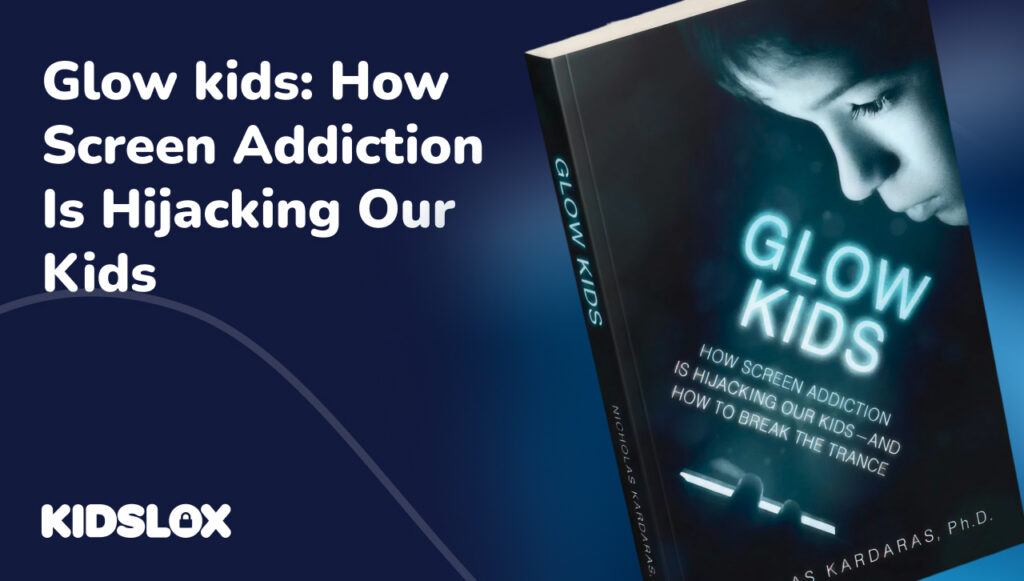
How Screen Addiction Is Hijacking Our Kids and How to Break the Trance by Dr Nicholas Kardaras
In summary:
- Glow Kids explores how excessive screen time can impact children’s brain development and argues that modern digital platforms are designed to be addictive.
- Author Dr. Nicholas Kardaras draws on neuroscience research and real clinical case studies to explain why children and teens may struggle to disengage from games, social media and devices.
- The book highlights the importance of screen time limits and digital boundaries.
- While powerful and thought-provoking, Glow Kids has been criticised for its alarmist tone.
- For parents concerned about screen addiction, Glow Kids serves as a wake-up call, reinforcing the value of balanced digital habits.
Glow Kids by Dr Nicholas Kardaras is one of the most talked about books on kids and screen time. Its central premise is a bold one. Screen addiction is real, widespread, and having a serious impact on the way our children’s brains and behaviour develop. But is the book alarmist, genuinely helpful, practical, or a mix of all three?
Who Is Nicholas Kardaras and What Is Glow Kids About?
Dr Nicholas Kardaras is a clinical psychologist and addiction expert who has spent years working with families and teenagers struggling with compulsive screen use. In Glow Kids, he argues that modern screens, especially games, social media, tablets and smartphones can become addictive in much the same way as drugs or alcohol when children and teens use them excessively.
Kardaras describes highly stimulating games and social platforms as ‘digital cocaine’, suggesting they tap directly into the brain’s reward system and make it very hard for young people to switch off or self-regulate.
That said, the book is not only about worst case scenarios. The subtitle, how to break the trance, makes it clear that Kardaras also wants to help families find a way forward. Alongside the warnings, he offers ideas for restoring balance and supporting healthier development.
What Glow Kids Argues
Screens Can Reshape Neurology and Behaviour
One of the book’s core arguments is that heavy screen use does more than distract children. Kardaras believes it can actively rewire the brain. Drawing on neuroscience research, he suggests that long periods spent with games and endlessly refreshing feeds stimulate dopamine in ways that closely resemble addictive behaviour.
According to the book, this can make children more likely to return to their devices again and again, while also contributing to reduced focus, weaker impulse control and changes in attention and emotional regulation.
Real World Addiction and Escapism
Glow Kids is rooted in real clinical case studies. Kardaras shares examples of teens and young adults whose school performance, relationships and emotional wellbeing were significantly affected by excessive screen use.
In many cases, these were not vulnerable or troubled children to begin with. Over time, screen habits gradually took over, leading to isolation, distraction and increasing difficulty managing everyday life without a device.
A Critique of Tech Culture and Digital Optimism
Kardaras does not place all the responsibility on children or parents. He is highly critical of the wider culture that normalises constant screen use. This includes tech companies that design products to keep users hooked, schools that rush to digitise learning in the name of innovation, and adults who underestimate just how powerful modern technology can be.
His concerns reflect a growing body of research suggesting that digital environments compete aggressively for children’s attention, often in ways we are only just beginning to fully understand.
What Glow Kids Gets Right
It Brings Attention to a Real Issue
Whether or not you agree with every conclusion, Glow Kids shines a light on something many parents already sense. Children today spend more waking hours with screens than many adults ever did growing up. That shift alone is worth paying attention to.
The book encourages parents to pause and ask some important questions. When does screen time start to become harmful? What might we be losing in terms of real connection, creativity and emotional presence?
It Emphasises the Need for Boundaries
Kardaras strongly advocates for structure. This includes screen free times, predictable family routines, outdoor play, better sleep habits and plenty of space for unstructured creativity.
This is an approach we strongly support at Kidslox. Even critics of the book often agree that clear limits and good adult role modelling are essential when it comes to healthy technology use.
These ideas naturally align with the tools Kidslox offers, such as consistent boundaries, age appropriate access to devices, and open conversations about screens and wellbeing.
Where the Book Draws Criticism
An Alarmist Tone
Some readers, particularly parents who already feel confident about their tech habits, may find the tone of Glow Kids overwhelming or fear driven. Kardaras sometimes presents screen use as universally harmful, without fully exploring nuance.
For example, educational screen use, shared gaming with friends, or technology that supports learning and connection can look very different from endless scrolling or solo gaming late into the night.
Repetition and Density
Another common criticism is that some sections of the book feel repetitive or heavy on research. While the evidence base is extensive, busy parents may find parts of the book dense or harder to translate into everyday action.
Not a One Size Fits All Solution
Families vary widely in their values, routines and children’s personalities. Kardaras’s approach can come across as one sided, with limited discussion of how technology might be used positively when guided and supported.
This does not make his perspective invalid, but it does mean it works best when balanced with other views. Many child development specialists now focus on guided engagement, helping children learn how to use screens responsibly, not just limiting how much time they spend on them.
What Glow Kids Means for Parents Today
Rethinking What Screen Time Really Is
One of the most helpful ideas in Glow Kids is the reminder that screen time is not just about minutes and hours. It is about behaviour shaped by design. Many apps and games are intentionally built to capture and hold attention, which makes setting boundaries even more important.
Why Intentional Boundaries Matter
Kardaras’s clinical experience supports what many parents already know. Structure reduces conflict. Clear rules remove daily negotiations and emotional battles.
Tools like Kidslox are not about punishment. They are about creating predictability in a digital world that is designed to be anything but predictable.
Making Space for Offline Life
Beyond reducing screen time, Glow Kids encourages parents to actively build up what replaces it. Play, creativity, movement, shared meals and in person connection all play a vital role in emotional resilience and healthy development.
Is Glow Kids Worth Reading?
Yes, with a few caveats.
Glow Kids is provocative and grounded in real clinical experience. For many parents, it will serve as a wake up call, especially if they have noticed rising anxiety, distraction or dependence on screens in their children.
It is not a gentle or reassuring handbook. It is a call to action. For that reason, it works best when read alongside other perspectives on digital wellbeing and modern parenting.
At Kidslox, where we help parents turn intention into action, Glow Kids is a valuable part of the conversation. It encourages awareness, prioritises offline life, and reminds us that technology should support children’s growth, not take it over.